Short answer: For a first trip, the top 10 places to visit in Australia are Sydney, the Great Barrier Reef, Uluṟu, Melbourne, the Great Ocean Road, the Blue Mountains, the Whitsunday Islands, Tasmania, Kakadu and K’gari. Together they cover the two great cities, the reef, the Red Centre, the tropical Top End, a classic coastal drive and some of the world’s most unusual islands.
Australia is about the size of the mainland United States, so distances are huge and most visitors fly between regions. This list is ordered the way we would recommend it for a first visit, starting with the places almost everyone wants to see. For each place you get why it made the list, the best time to go, what not to miss, how to get there and how long to stay, plus one practical note. Prices are in Australian dollars, as of October 2026. Remember that the seasons are reversed: summer runs from December to February and winter from June to August.
1. Sydney
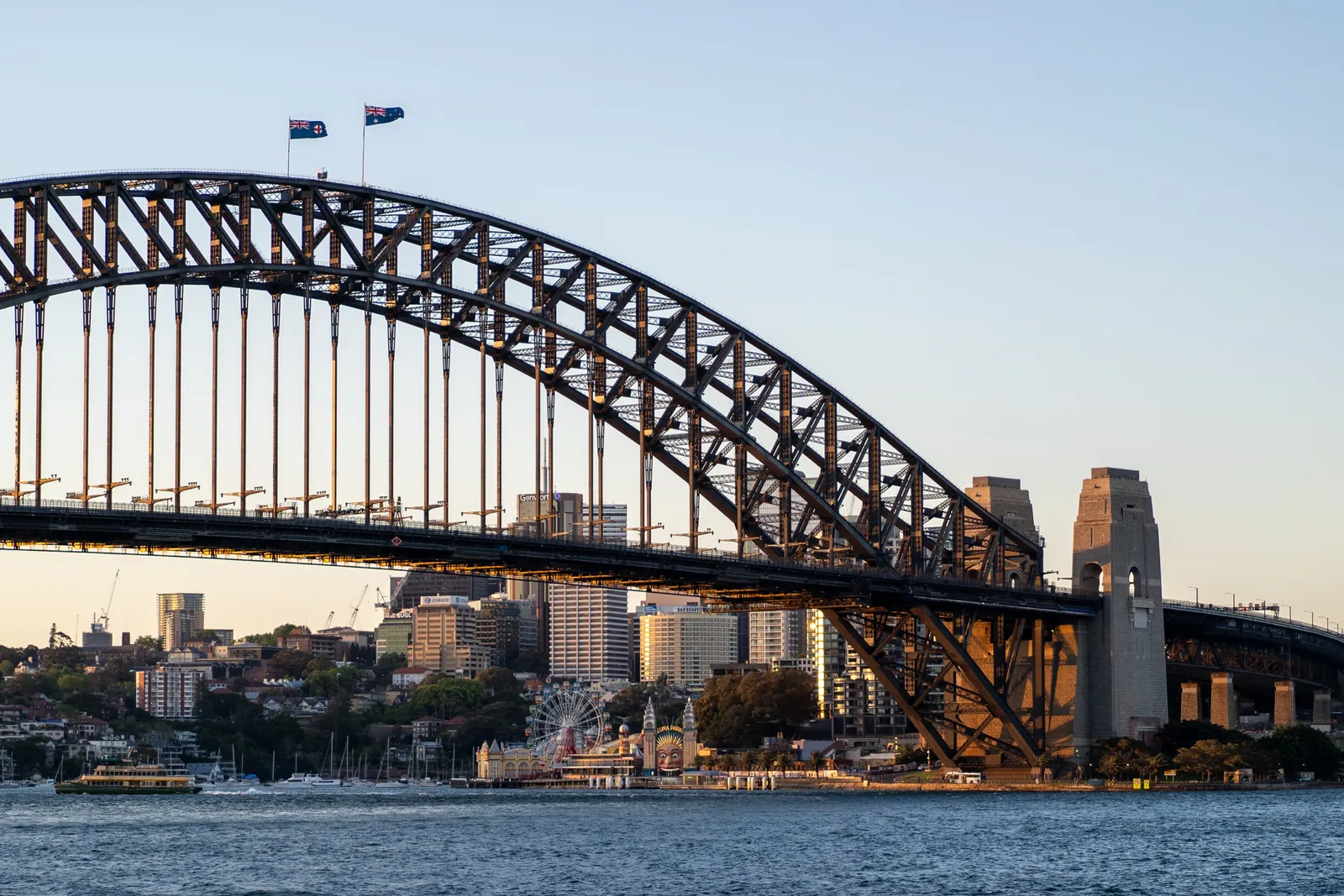
Sydney is the Australia most visitors picture first: the white sails of the Opera House, the steel arch of the Harbour Bridge, ferries crisscrossing a deep blue harbor and golden surf beaches a short bus ride from the skyscrapers. About 5.5 million people live in Greater Sydney, the country’s largest and oldest city.
Best time: March to May and September to November for warm, settled days; December to February for the beach, with humid spells and storms. Winter is mild and mostly sunny, around 64°F (18°C) by day.
Don’t miss: a harbor ferry from Circular Quay to Manly, and the coastal walk from Bondi. In winter, Vivid Sydney lights up the harbor from 28 May to 19 June 2027.
Getting there and how long: Sydney is the main international gateway. Give it four days, plus one for the Blue Mountains.
Practical note: you can tap on trains, buses, ferries and light rail with a contactless card or phone, and adult fares are capped at $19.30 a day Monday to Thursday and $9.65 Friday to Sunday, so weekend ferry trips are a bargain. See our Sydney travel guide.
2. The Great Barrier Reef, Cairns and Port Douglas
The Great Barrier Reef is the world’s largest coral reef system, a chain of roughly 3,000 reefs and hundreds of islands stretching about 1,400 miles (2,300 km) along the Queensland coast, and a UNESCO World Heritage Site since 1981. You don’t visit it in one place: you choose a gateway town and take a boat out.
Best time: May to October, the dry season, with the calmest seas often from September to November. The wet season, December to April, brings heavy rain, cyclone risk and marine stingers, though reef trips still run on most days.
Don’t miss: a full day on the outer reef, snorkeling or diving, and the Daintree rainforest north of Port Douglas.
Getting there and how long: fly to Cairns, then stay in Cairns or in quieter Port Douglas, about an hour north. Allow four days.
Practical note: every reef visitor pays an environmental management charge of $8.50 for a full day ($9.00 from 1 April 2027), collected by the tour operator, usually in your ticket. See our Cairns travel guide.
3. Uluṟu-Kata Tjuṯa National Park
In the red heart of the country, Uluṟu is the vast sandstone monolith that glows orange and crimson at sunrise and sunset, and Kata Tjuṯa is a cluster of 36 steep-sided domes 31 miles (50 km) away by road. Both are sacred to the Aṉangu, who own the park and manage it jointly with Parks Australia.
Best time: May to September, with sunny days around 69–75°F (20–24°C) and cold nights, often near freezing at dawn. From October to March, temperatures regularly top 95°F (35°C).
Don’t miss: sunset at the Uluṟu viewing area, and the 6.6-mile (10.6 km) base walk around the rock, about three and a half hours. At Kata Tjuṯa, walk the Valley of the Winds.
Getting there and how long: fly to Ayers Rock Airport, about three hours from Sydney; all accommodation is at Yulara (Ayers Rock Resort), just outside the park. Two or three nights is ideal.
Practical note: visitors walk around Uluṟu, not over it: the climb closed permanently in October 2019. A park pass costs $38 for adults and is valid for three days. See our Uluṟu-Kata Tjuṯa National Park guide.
4. Melbourne
Australia’s second city wins visitors over with laneways full of espresso bars and street art, free art galleries, trams on tree-lined boulevards and some of the best food in the country, thanks to its large Greek, Italian, Vietnamese, Chinese and Indian communities.
Best time: autumn, March to May, is often the most settled season. Summer brings warm days with occasional hot northerlies, and winter is cool and gray. Locals joke about four seasons in one day.
Don’t miss: the National Gallery of Victoria, free and open daily, and the laneways and arcades of the city center. Sports fans can catch the Australian Open, at Melbourne Park from 11 to 31 January 2027.
Getting there and how long: Melbourne has a big international airport and a SkyBus to the city. Give it three days, plus the Great Ocean Road.
Practical note: trams in the Free Tram Zone, covering the city center and Docklands, cost nothing. See our Melbourne travel guide.
5. The Great Ocean Road
One of the world’s great coastal drives: about 150 miles (240 km) of road hugging the cliffs, surf beaches and rainforest of Victoria’s southwest coast. Returned soldiers built it between 1919 and 1932 as a memorial to those killed in World War I, and it remains the world’s largest war memorial.
Best time: December to April for the best weather; winter for stormy cliffs and whales.
Don’t miss: the limestone stacks of the Twelve Apostles at sunset, koalas in the treetops at Kennett River, and the waterfalls and giant tree ferns of the Otway Ranges.
Getting there and how long: the road starts at Torquay, about an hour and a half from Melbourne. You can see the Twelve Apostles on a very long day trip, but the road rewards two to four days, with nights in Lorne, Apollo Bay or Port Campbell.
Practical note: the beach access steps at Loch Ard Gorge are closed because of geological instability; you can still see the gorge from the lookouts. See our Great Ocean Road travel guide.
6. The Blue Mountains
About two hours west of Sydney, the Blue Mountains are a deeply eroded sandstone plateau of sheer cliffs, forested valleys, waterfalls and lookouts, named for the blue haze given off by millions of eucalyptus trees. The national park forms the core of the UNESCO-listed Greater Blue Mountains World Heritage Area.
Best time: spring and autumn for walking. At about 3,300 feet (1,000 m), the upper mountains are noticeably cooler than Sydney, with crisp winters and occasional snow.
Don’t miss: the Three Sisters from Echo Point in Katoomba, and a ride on Scenic World’s Scenic Railway, the steepest passenger railway in the world at a 52-degree incline.
Getting there and how long: trains run from Sydney, so it makes an easy day trip, but a night or two lets you walk the cliff-top tracks at dawn and dusk, when the light is best and the crowds thin.
Practical note: the national park is free to enter, except for an $8 vehicle fee at the Glenbrook-area attractions. See our Blue Mountains travel guide.
7. The Whitsunday Islands
A cluster of 74 islands in the sheltered, turquoise waters between the Queensland coast and the Great Barrier Reef, most of them uninhabited national park. The most famous sight is Whitehaven Beach, whose dazzling silica sand swirls with the tide at Hill Inlet.
Best time: August to October is often the sweet spot: dry, sunny and calmer. Humpback whales calve here from about July to September.
Don’t miss: the Hill Inlet lookout above Whitehaven Beach, and a sailing trip or a seaplane flight over Heart Reef.
Getting there and how long: stay on the mainland at Airlie Beach, a lively boating town, or on Hamilton Island, the only island with its own commercial airport, with direct flights from Sydney, Melbourne, Brisbane and Cairns. Allow three or four days.
Practical note: this is crocodile and stinger country, so swim where operators and signs say it is safe, and wear a stinger suit in the wet season. See our Whitsunday Islands travel guide.
8. Tasmania: Hobart and Cradle Mountain
Australia’s island state packs a harbor city, convict history and alpine wilderness into a small area. Hobart, the second-oldest city in the country, is a harbor town of sandstone warehouses under kunanyi/Mount Wellington, with MONA, the provocative Museum of Old and New Art. In the Central Highlands, Cradle Mountain-Lake St Clair National Park is the heart of the Tasmanian Wilderness World Heritage Area.
Best time: December to March, for mild days around 70–73°F (21–23°C) and long evenings; late April for golden beech in the mountains.
Don’t miss: the ferry up the river to MONA, and the walk around Dove Lake under the craggy peak of Cradle Mountain. Serious hikers can tackle the Overland Track, a 40-mile (65 km), six-day trek.
Getting there and how long: fly to Hobart or Launceston, or take the Spirit of Tasmania ferry from Geelong, near Melbourne. Give Tasmania five days to a week, with a car.
Practical note: you need a Tasmanian parks pass, and during the day you reach Dove Lake by shuttle bus from the visitor center, not by car. Metro Tasmania buses are free statewide until 30 June 2027.
9. Kakadu National Park and Darwin
About three hours’ drive east of Darwin, Kakadu is Australia’s largest national park on land, almost 7,600 square miles (20,000 km²) of floodplains, monsoon forest and sandstone escarpment, listed by UNESCO for both its natural and its cultural values. Its rock art galleries at Ubirr and Burrungkuy (Nourlangie) are among the oldest and finest anywhere.
Best time: May to September, when skies are clear, humidity is low and the park’s roads, walks and swimming holes open. From about November, monsoon rain floods the plains and closes unsealed roads.
Don’t miss: sunset from the rock at Ubirr, and a Yellow Water cruise to see saltwater crocodiles and birdlife.
Getting there and how long: fly to Darwin and drive in; there are no commercial flights to the park. Allow at least three days in Kakadu.
Practical note: the Jim Jim and Twin Falls area is closed through 2026 for road repairs and is due to reopen for the 2027 dry season. Check Parks Australia’s Kakadu Access Report before you go.
10. K’gari
K’gari, formerly Fraser Island, is the largest sand island in the world: about 710 square miles (1,840 km²) of dunes, rainforest growing on sand, more than 100 freshwater lakes and a 75-mile (120 km) surf beach. It is a UNESCO World Heritage site, and K’gari, the Butchulla people’s name for the island, means “paradise.”
Best time: June to October, for driving and walking in dry, sunny weather.
Don’t miss: a swim in the clear blue water of Lake McKenzie (Boorangoora), and the rusting wreck of the Maheno on the eastern beach.
Getting there and how long: K’gari is about 3.5 to 4 hours’ drive north of Brisbane. There are no sealed roads: you arrive by vehicle barge and explore in a four-wheel drive, or join a 4WD tour. Allow two or three days.
Practical note: you need a vehicle access permit to drive on the island, and you must follow the dingo-safe rules; never feed the island’s wild dingoes. See also our guides to Brisbane and the Sunshine Coast.
How to fit them into one trip
Australia rewards focus. For a first trip of two to three weeks, spend four or five days in Sydney with a day or night in the Blue Mountains, fly to Uluṟu for two or three nights, then fly to Cairns for the reef (there are direct flights). Finish in Melbourne, with two or three days on the Great Ocean Road. If you travel between May and September, the reef, Uluṟu and Kakadu are all at their best; if you travel in our summer, the southern cities and Tasmania shine instead. With more time, add the Whitsundays between Cairns and Brisbane, or K’gari on a drive up the Queensland coast.
Our AI trip planner builds the day-by-day plan for your dates. To pick the month, read our best time to visit Australia guide.
Plan your trip
Start with our Australia travel guide for entry, costs and getting around. Check typical weather for your dates with the Destination weather tool, and use our packing list for a trip that spans tropical and temperate climates.
Frequently asked questions
What is the most beautiful place in Australia?
Many travelers would say Whitehaven Beach in the Whitsundays, the Twelve Apostles on the Great Ocean Road or Uluṟu at sunset. For wilderness, Cradle Mountain in Tasmania is hard to beat.
What is the best place in Australia for first-time visitors?
Sydney. It is the main gateway, it has the harbor, the beaches and the Opera House, and the Blue Mountains are an easy trip from the city. Add the Great Barrier Reef and Uluṟu for the full picture.
How many days do you need in Australia?
At least two weeks for a first trip, which lets you see Sydney, the reef and Uluṟu, or Sydney, Melbourne and the Great Ocean Road. Three weeks lets you combine the south, the reef and the Red Centre without rushing.
When is the best time to visit Australia?
Spring (September to November) or autumn (March to May), when the south is warm but not hot and the tropical north and Uluṟu are dry. For the reef, Cairns, Darwin and the Red Centre, May to October is best.
Can you still climb Uluṟu?
No. The climb closed permanently in October 2019. You can walk the 6.6-mile (10.6 km) base walk around the rock instead, and join the shorter ranger-guided walks.
Is Tasmania worth adding to an Australia trip?
Yes, if you have a week or more to spare and like nature. It combines Hobart and MONA with Cradle Mountain and the convict history of Port Arthur, and it is at its best from December to March.