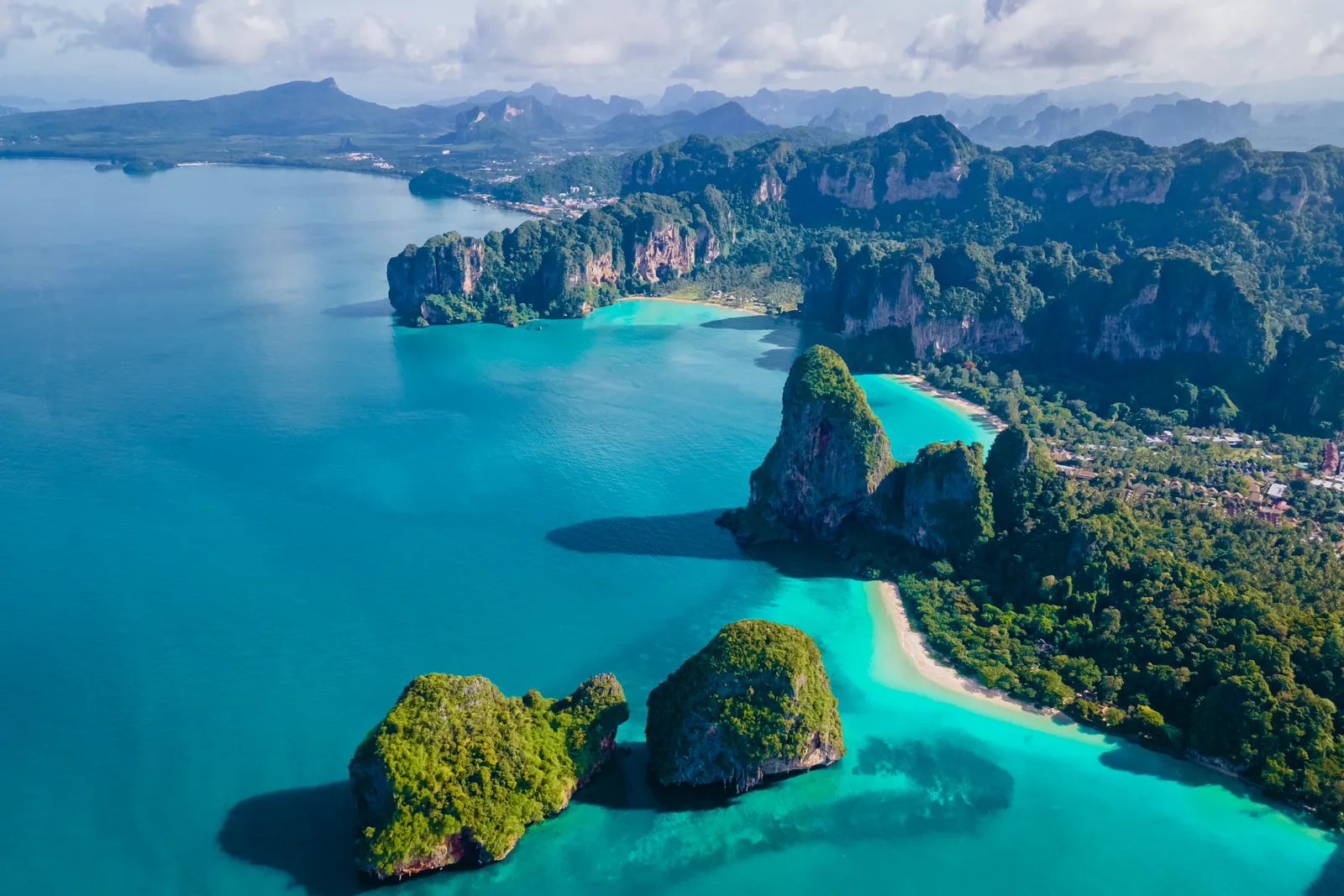
Short answer: For a first trip to Thailand, the top places to visit are Bangkok, Chiang Mai, Ayutthaya, Phuket, Krabi’s Ao Nang and Railay, Ko Phi Phi, Ko Samui, Chiang Rai, Kanchanaburi and Khao Yai National Park. Together they give you the capital’s temples and food, the cool mountain north, an old royal capital, the best beaches on both coasts and a real taste of the jungle.
This list is ordered the way we would plan a first visit: the big city, then the north and the history, then one coast. Each place links to our full guide.
1. Bangkok
Why it made the list: almost every trip starts in Bangkok, and it deserves more than a stopover. The capital sits on the Chao Phraya River, with gilded temples a few streets from glass towers and some of the world’s best street food cooked on the sidewalk.
Best time: November to February, when highs are about 32–33°C (90–91°F) and there is little rain. April is the hottest month, and September is the wettest.
Don’t miss: the Grand Palace and the Temple of the Emerald Buddha, open daily from 8:30 a.m. to 4:30 p.m. (last tickets at 3:30 p.m.), with entry at 500 baht for foreign visitors. Then cross the river to Wat Arun, the Temple of Dawn, by the short ferry from Tha Tien pier.
Getting there and how long: Bangkok has two international airports, Suvarnabhumi (BKK) and Don Mueang (DMK). Give it three to four days for the main sights and a day trip.
Practical note: the palace has a strict dress code, with no sleeveless tops, shorts or torn pants, so dress for it before you leave the hotel. See our Bangkok travel guide.
2. Chiang Mai
Why it made the list: the capital of the north is the perfect contrast to Bangkok: a relaxed, green city in a valley ringed by forested mountains, with more than a hundred temples in and around its moated old city.
Best time: November to January is ideal, with warm, sunny days and nights around 16°C (60°F) in January. From about February to April, smoke from crop and forest fires often hangs over the north.
Don’t miss: Doi Inthanon, Thailand’s highest point at 2,565 m (8,415 ft), as a day trip into the cloud forest. If you can time it, come for Yi Peng and Loy Krathong, held together on November 24 in 2026, when candle-lit baskets float on the Ping River and lanterns light up the old city.
Getting there and how long: it is about 1 hour 15 minutes by air from Bangkok, and the airport is close to the city; the overnight train takes about 11 to 13 hours. Stay three to four days, or a week to add Chiang Rai or Pai.
Practical note: Doi Inthanon’s Kio Mae Pan nature trail closes every year from June 1 to October 31, according to the national parks department. See our Chiang Mai travel guide and our hiking guide.
3. Ayutthaya
Why it made the list: Ayutthaya was the capital of Siam from 1350 until it was sacked in 1767, and its ruined palaces and temples, spread over an island ringed by three rivers, are now the Historic City of Ayutthaya, a UNESCO World Heritage site since 1991. It sits only about 80 km (50 miles) north of Bangkok.
Best time: November to February, when it is dry; go early in the morning year-round.
Don’t miss: exploring the flat island by bicycle, from one ruin to the next, then a late-afternoon long-tail boat ride around the island past Wat Chaiwatthanaram as the sun goes down.
Getting there and how long: about 1.5 to 2 hours from Bangkok by train, minivan or car. It works as a long day trip, but one or two nights let you see the ruins in the soft morning and evening light.
Practical note: Ayutthaya holds traditional celebrations at Loy Krathong and has elephants joining the water splashing at Songkran in April. See our Ayutthaya travel guide and our cycling guide.
4. Phuket
Why it made the list: Thailand’s largest island is its most popular and easiest beach destination, with a string of white-sand bays on the west coast, hotels for every budget and boat trips to the best of the Andaman Sea.
Best time: December to March, with the calmest seas; February is the driest month, with only about 24 mm (0.9 in) of rain. From May to October, the southwest monsoon brings most of the year’s rain and red flags on the west-coast beaches.
Don’t miss: sunset at Promthep Cape, the island’s southern tip, and a boat trip to the Phi Phi or Racha islands. Divers can head to the Similan Islands (open October 15 to May 15) from Khao Lak, north of Phuket.
Getting there and how long: Phuket International Airport (HKT) is about 1 hour 20 minutes by air from Bangkok. Plan four to five days for beaches and two boat trips.
Practical note: the Christmas and New Year weeks are the busiest and most expensive of the year, so book rooms and boat trips early. The Phuket Vegetarian Festival takes over the island’s Chinese shrines from October 10 to 18 in 2026. See our Phuket travel guide and our Khao Lak travel guide.
5. Ao Nang and Railay, Krabi
Why it made the list: this is the coast from the postcards: a bay framed by towering limestone cliffs, with dozens of islands offshore. Ao Nang, Krabi’s main beach town, is the most convenient base for island-hopping, with long-tail boats leaving straight from the beach.
Best time: December to March, when the sea is calm and the boats run every day; November and April are good shoulder months.
Don’t miss: Railay, a peninsula cut off by cliffs and reached only by boat, about 15 minutes by long-tail, with Phra Nang Cave Beach, one of Thailand’s most beautiful. Add an island-hopping day.
Getting there and how long: Krabi International Airport (KBV) is about 30–40 minutes from Ao Nang by road and about 1 hour 20 minutes by air from Bangkok; ferries arrive from Phuket and Ko Phi Phi. Stay three to four days.
Practical note: the Tourism Authority of Thailand has chosen Krabi for its “Krabi Prototype” sustainable-tourism program, so expect national-park rules on some islands. Ko Lanta, about 2 hours away, is a quieter base. See our Ao Nang travel guide, Ko Lanta travel guide and boat trips guide.
6. Ko Phi Phi
Why it made the list: the Phi Phi Islands are the most famous islands in Thailand, with sheer cliffs, clear water and Maya Bay, the beach made famous by the film The Beach.
Best time: December to March, with calm, clear water. Maya Bay, Loh Samah Bay and Ao Loko close every year from August 1 to September 30, according to the national parks department.
Don’t miss: the hike up to the viewpoints above Tonsai village for the view of the twin bays, best at sunrise or sunset, and a boat trip around Phi Phi Leh.
Getting there and how long: by boat only, about 1.5–2 hours from Phuket, Ao Nang or Krabi Town, and about 1–1.5 hours from Ko Lanta. Spend two or three nights; a day trip works if time is short.
Practical note: Mosquito Island (Ko Yung) is closed to visitors indefinitely, so skip tours that still list it. See our Ko Phi Phi travel guide and our snorkeling guide.
7. Ko Samui
Why it made the list: Ko Samui is the Gulf of Thailand’s answer to Phuket, with palm-lined beaches, villa resorts and spas, ranked first among islands in the Travel + Leisure Luxury Awards Asia Pacific 2026. It also opens up two very different neighbors: Ko Pha Ngan and Ko Tao, one of the busiest places in the world to learn to dive.
Best time: Samui follows a different calendar from the Andaman coast. It is best from January to September, with February to April the driest and calmest months, and wettest from October to December; November alone averages about 445 mm (17.5 in) of rain.
Don’t miss: a day trip to the 42 islands of Mu Ko Ang Thong National Park, with kayaking and a walk to the Emerald Lake, and a ferry hop to Ko Pha Ngan or Ko Tao.
Getting there and how long: about 1 hour by air from Bangkok to Samui Airport (USM), or by flight or train to Surat Thani and a ferry from the mainland. Stay four to five days, or a week with the neighboring islands.
Practical note: Ang Thong Marine National Park closes every year from November 1 to December 15, according to the national parks department. See our Ko Samui travel guide and our diving guide.
8. Chiang Rai
Why it made the list: Thailand’s northernmost province capital is a small, easygoing city best known for its extraordinary modern temples, above all the dazzling White Temple (Wat Rong Khun) and the Blue Temple.
Best time: November to February, with highs of about 28–31°C (82–88°F) and cool nights. In January, wild Himalayan cherry trees bloom pink in the hills.
Don’t miss: the White Temple early in the morning, then the Blue Temple; on a second day, drive to the Golden Triangle viewpoint at Sop Ruak and the ruins of Chiang Saen, about an hour north.
Getting there and how long: about 3 hours by road from Chiang Mai, or about 1 hour 20 minutes by air from Bangkok; there is no railway. Stay two to three days.
Practical note: it works as a long day trip from Chiang Mai, but one night is far more relaxed. See our Chiang Rai travel guide.
9. Kanchanaburi
Why it made the list: Kanchanaburi, west of Bangkok, is where World War II history meets river scenery. The Bridge on the River Kwai was built by prisoners of war in 1943 as part of the Death Railway, and the town’s museum and war cemeteries tell the story.
Best time: November to February, with highs of about 32–33°C (89–91°F) and almost no rain.
Don’t miss: walking across the bridge, then riding the State Railway’s train along the old Death Railway to Nam Tok, past the Wang Pho viaduct, a wooden trestle built against a cliff above the river.
Getting there and how long: about 2–3 hours by bus or minivan from Bangkok, or a slow, scenic train from Thonburi station. Stay two days for the town, the bridge and the railway, or three to four with the national parks.
Practical note: Erawan National Park, with its tiered waterfalls, and Sai Yok National Park were both closed temporarily in late September 2026 after heavy rain, according to the national parks department. Check that they have reopened before you plan around them. See our Kanchanaburi travel guide.
10. Khao Yai National Park
Why it made the list: Thailand’s first national park, established in 1962, is part of a UNESCO-listed forest complex and the best place in the country to see wildlife in the wild, including elephants, hornbills and gibbons. It covers more than 2,100 km² (810 sq miles) of forested hills.
Best time: November to February, when it is dry and cool. The waterfalls are fullest from August to October, but trails are muddy and leechy then.
Don’t miss: a dawn or dusk drive along the park road to look for wildlife, a guided trek, and the waterfalls.
Getting there and how long: about 3 hours by car from Bangkok, or a bus, minivan or train to Pak Chong and a songthaew to the park gate; there is no public transport inside the park. One long day covers the highlights; two or three days give you the best wildlife hours.
Practical note: some viewpoints, trails and waterfalls close for part of the year, such as the Pha Diao Dai viewpoint from June 1 to September 30, according to the national parks department. See our Khao Yai National Park travel guide.
How to fit them into one trip
Build the trip in three blocks and pick one coast.
- Bangkok and the central plains (4–6 days): three or four days in Bangkok, with Ayutthaya as a day trip or overnight. Add Kanchanaburi or Khao Yai for two days if you like history or wildlife.
- The north (4–6 days): fly to Chiang Mai for three or four days, then go by road to Chiang Rai for two nights and fly back to Bangkok from there.
- One coast (5–7 days): from November to April, choose the Andaman side: Phuket, Ao Nang and Railay, with two or three nights on Ko Phi Phi in between. From January to September, Ko Samui and its neighbors Ko Pha Ngan and Ko Tao are the better bet.
That makes about two weeks for a city, the north and a beach; with ten days, drop one of the three side trips and keep the coast to two bases. Our best time to visit Thailand guide matches the coast to your month. When you have your dates, our AI trip planner builds the day-by-day plan for your dates, travelers and budget from our guides.
Plan your trip
Start with our Thailand travel guide for entry rules, the digital arrival card and getting around, then use the Destination weather tool to see what the weather is usually like on your exact dates at each stop. The Money exchange tool turns baht prices into your own currency.
Frequently asked questions
What is the most beautiful place in Thailand?
For scenery, most travelers would pick the Krabi coast: the limestone cliffs of Railay and Phra Nang Cave Beach, and the bays of Ko Phi Phi. Ayutthaya’s ruins at sunset are a close second.
How many days do you need in Thailand?
Ten days to two weeks lets you combine Bangkok, the north and one coast. With a week, choose Bangkok plus either Chiang Mai or a beach.
What is the best place in Thailand for first-time visitors?
Bangkok, followed by Chiang Mai. Bangkok gives you the Grand Palace, the river and the food; Chiang Mai shows you a calmer, greener Thailand. For the beach, Phuket is the easiest first choice, with an international airport and the widest range of hotels and boat trips.
Which is better, Phuket or Ko Samui?
It depends mostly on the month. Phuket and the Andaman coast are best from November to April, and Ko Samui and the Gulf islands from January to September. Phuket is bigger and busier; Samui is calmer, with villas, spas and nearby islands.
Is Sukhothai worth visiting as well as Ayutthaya?
Yes, if you love history and have the time. Sukhothai, an earlier capital, is also a World Heritage site, with a quieter, greener historical park, and it makes a good stop on the way north. See our Sukhothai travel guide.